
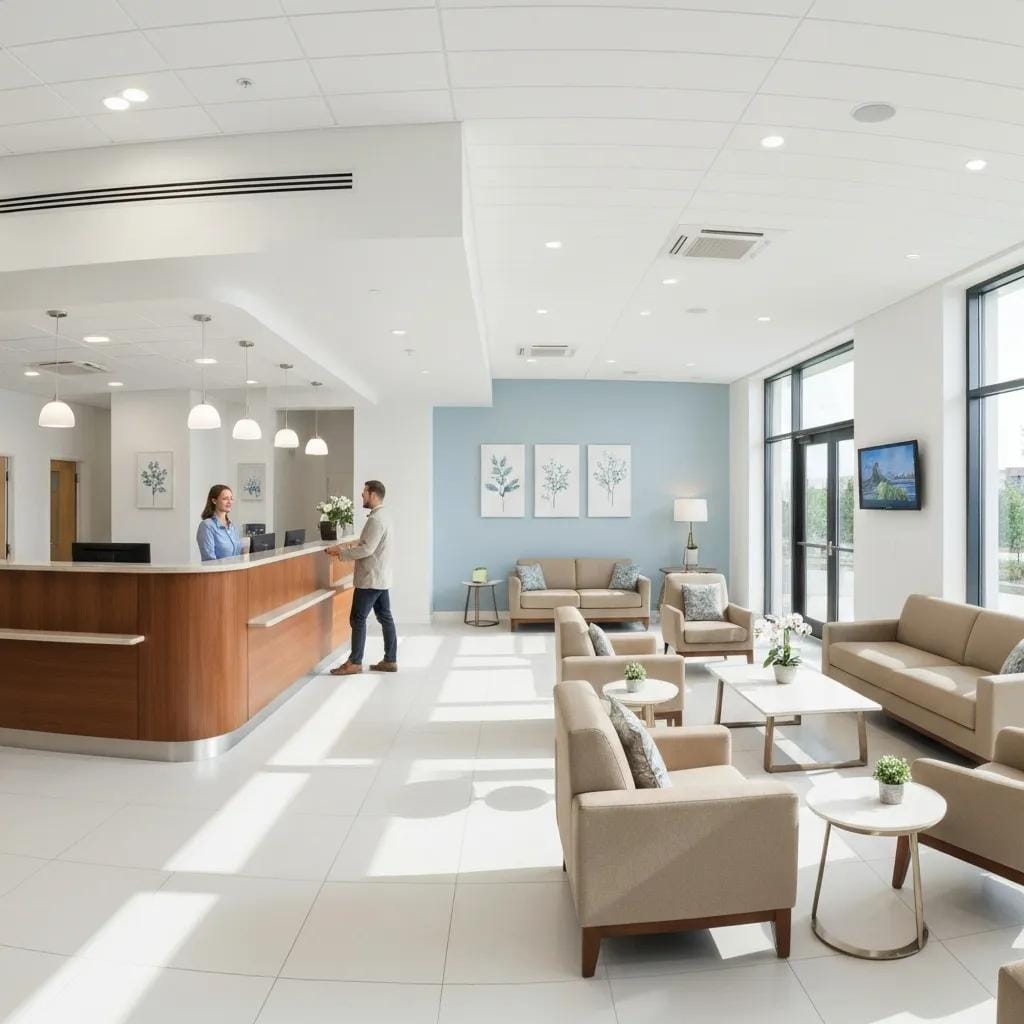
Opening a clinic requires data-backed decisions on space and costs. This guide provides a practical, room-by-room method to size a clinic, linking calculations to provider-to-exam-room ratios and translating build-out options into negotiable tenant improvement (TI) and lease numbers. Independent physicians, clinic leaders, and practice planners will find step-by-step formulas, service-line adjustments (primary care, cardiology, behavioral health, urgent care, imaging, infusion, CLIA labs), and scenario planning for years 1, 3, and 5. We also cover workflow, patient-flow, and core real estate cost drivers—TI, amortized TI, Triple Net (NNN) charges, and effective rent—to help you compare offers. Continue for tables, build-out comparisons, a calculator walkthrough, and a negotiation checklist.
What Are the Core Space Requirements for a Medical Clinic?
Core space requirements define a clinic’s functional footprint, scaling with provider count and services. Patient-facing zones (exam, procedure, lab, imaging) typically comprise 60–70% of net usable area, forming the operational core. Support spaces (reception, waiting, admin, staff, storage) make up the remainder, sized by throughput and staff. Circulation (corridors) commonly adds 15–20% of the net program area. Optimizing these allocations is critical for operational efficiency and patient flow (Al-Hajri et al., 2020). These allocations, combined with a load factor (e.g., 1.3–1.5 for medical offices), convert projected visit volumes and staff into gross square footage. The table below offers a practical room-by-room sizing starting point for most ambulatory practices.
Common clinical and support room types and their typical sizes include:
- Exam room: the clinical space for history-taking, exam, and minor procedures.
- Procedure / Minor OR: space for procedures that need extra clearance and equipment.
- Provider office: private workspace for charting, telehealth, and consultations.
- Waiting and reception: patient-facing circulation and check-in area.
| Room Type | Typical Size Range | Equipment / Notes |
|---|---|---|
| Exam room | 100–120 sq ft | Exam table, sink, computer workstation, ADA clearance |
| Procedure room | 160–250 sq ft | Procedure table/chair, scrub sink, extra clearance for equipment |
| Provider office | 100–150 sq ft | Desk, charting area, telehealth setup; typically adjacent to clinic core |
| Lab / CLIA area | 150–300 sq ft | Work benches, centrifuge, refrigeration, dedicated sink/drainage |
| Waiting area | 13–16 sq ft per seat | Located near reception with sight lines to clinical zone |
| Administrative office | 120–180 sq ft | Billing, scheduling, records storage |
| Storage / Supplies | 3–8% of total sq ft | Medical supplies, PPE, linen, secure medication storage |
| Staff break / Training | 100–200 sq ft | Lockers, small kitchen, staff training area |
| Utility / Mechanical | Varies | HVAC, med-gas room, IT closet, electrical panels |
This table provides an operational baseline; specialties with heavy equipment or unique workflows may require larger spaces. Subsequent sections convert provider counts and visit volumes into room counts and total square footage, ensuring proper circulation and adjacencies.
What Are the Standard Exam Room Dimensions and Provider Ratios?
Standard exam rooms typically measure 100–120 sq ft, accommodating clinical needs, ADA clearance, EHR workstations, and small equipment. Provider-to-exam-room ratios are a key determinant of clinic efficiency, with studies suggesting optimal ranges based on specialty and visit duration (Al-Hajri et al., 2020). Primary care often uses 1.0–1.5 rooms per FTE provider, while procedure-heavy specialties or urgent care may need 1.2–2.0 or more. These ratios reflect room turns; shorter visits allow higher utilization. Shared-room models require standardized equipment and tight scheduling for efficient turnover, whereas unpredictable schedules may favor dedicated rooms. Understanding these ratios directly informs total room and waiting-area needs based on visit volume and average visit length.
How Much Space Is Needed for Waiting, Reception, and Administrative Areas?
Waiting and reception areas are sized for peak patient load and desired comfort. A guideline of 13–16 sq ft per seated patient is common for clinical waiting rooms, with extra space for peak circulation to prevent bottlenecks. Sizing waiting areas to accommodate peak patient loads is crucial for patient flow and satisfaction (Al-Hajri et al., 2022). Reception desks need clear sightlines for patient flow, check-in, scheduling, and discrete check-out; one staff member typically manages 10–15 visit starts per hour, depending on digital adoption. Back-office spaces (billing, records, practice manager) scale with staff, often comprising 10–20% of the program for small practices. Circulation (corridors, clean/soiled flow) commonly adds 15–20% of the net clinical area for efficient movement and code compliance. These choices impact provider productivity and determine exam and procedure room needs, which the next section converts into space requirements.
How Do Provider Count and Service Lines Influence Medical Office Space Needs?
Estimate total clinic square footage using: Total sqft = fixed support sqft + (providers × sqft per provider) + service-line adjustments. Fixed support includes waiting, reception, admin, storage, and utilities. Sqft per provider accounts for exam rooms, provider offices, and shared support. Service-line adjustments are significant: cardiology adds echo/procedure rooms, infusion needs larger bays/utilities, imaging requires shielding/reinforced floors, and behavioral health favors private consult spaces with sound attenuation. Treat each provider as a module, sum these, then apply support and circulation percentages for gross square footage.
Counting providers as full-time equivalents (FTEs) impacts room needs, as part-time providers reduce demand for dedicated rooms. Translate visit volume to exam-room demand using room-turn math: visits per room per day = clinic hours × (60 / average visit length) × room utilization factor. Convert expected daily visits into simultaneous rooms, apply your provider module, to derive exam room counts and per-provider footprint. This informs service-line uplift discussions.
How Does Visit Volume Affect Square Footage Planning?
Visit volume drives exam-room counts through room-turn calculations. For example, an 8-hour clinic day with 20-minute visits yields approximately 24 visits per room per day; dividing daily visits by 24 gives required exam rooms. Low-volume clinics (under 50 visits/day) can use room-sharing and reduced provider-to-room ratios, while higher-volume clinics often need more dedicated rooms or extended hours. Incorporating a buffer of 15–25% for growth, no-shows, and procedural needs is a common strategy to maintain operational flexibility (van der Velden et al., 2021). Size waiting/recovery areas for peak arrivals to prevent bottlenecks. Translating room demand into gross square footage, including fixed support and circulation, informs lease negotiation and TI budgeting.
What Are Space Adjustments for Different Service Lines Like Cardiology or Behavioral Health?
Service lines alter room dimensions and infrastructure. Specialized service lines, such as cardiology, infusion, and behavioral health, necessitate distinct room dimensions and infrastructure to support unique equipment and patient care models (Singh et al., 2023). Cardiology often requires 200–300 sq ft for echo/stress testing, demanding specialized equipment and enhanced electrical/data. Imaging (X-ray, ultrasound, CT) needs shielding, larger rooms, and equipment storage, increasing TI costs. Infusion suites require 60–100 sq ft per chair for reclining chairs/beds, spacing, sinks, IV plumbing/med-gas, and private/semi-private bays. Behavioral health prioritizes privacy and sound attenuation, with smaller exam footprints but more consult rooms and discrete waiting. Each service line also impacts staff ratios and support functions; labs, for instance, need specimen processing and secure storage, with CLIA certification defining bench and workflow. These infrastructure demands directly influence TI budgeting and build-out strategy.
What Are the Key Real Estate Cost Factors for Medical Clinic Build-Outs?
Key real estate cost drivers are tenant improvements (TI) and Triple Net (NNN) operating expenses, both impacting effective rent and project economics. TI converts a shell into a clinic, covering partitions, finishes, clinical plumbing, medical gas, HVAC zoning, and specialty installs like shielding or lab benches; TI ranges vary by shell condition and specialty. NNN leases pass property costs (CAM, taxes, insurance) to the tenant, requiring careful review as CAM allocations can increase operating costs. Effective rent = base rent + amortized TI + estimated NNN charges, allowing for apples-to-apples comparison of landlord offers. The table below clarifies lease and cost items and common negotiation levers.
Key negotiation levers and considerations before reviewing offers:
- Request a TI allowance tied to a written landlord scope of work.
- Ask for rent abatement during the build-out period to avoid paying full rent while closed.
- Limit CAM exposure with caps or an operating-expense stop and insist on detailed CAM reconciliation and audit rights.
| Lease / Cost Item | What It Includes | Typical Range & Negotiation Levers |
|---|---|---|
| Tenant Improvements (TI) | Interior build-out: partitions, finishes, clinical plumbing, HVAC adjustments | Varies by shell condition and specialty; negotiate allowance, landlord scope, amortization |
| CAM (Common Area Maintenance) | Shared property operating expenses: landscaping, cleaning, building services | Usually billed pro rata; request caps, exclusions, and audit rights |
| Property Taxes & Insurance | Building taxes and insurance passed through in NNN leases | Allocated pro rata; confirm tax base and appeals process |
| Base Rent vs Effective Rent | Base rent quoted; effective rent includes amortized TI and concessions | Amortize TI over lease term to compare offers; seek longer term if landlord funds TI |
This table aids in converting quoted rent and TI offers into comparable effective rent metrics. Next, we review typical TI cost ranges by build-out scenario and amortization’s impact on monthly occupancy costs.
What Are Tenant Improvements and Typical Cost Ranges Per Square Foot?
TI costs vary by existing condition and clinical complexity. Existing medical spaces are usually least expensive, often having clinical-grade finishes, exam plumbing, and med-gas, leading to shorter timelines and reduced scope. Vanilla commercial shells require installing clinic infrastructure (plumbing, sinks, exam-grade finishes, HVAC zoning, partitions), resulting in moderate to high TI costs. Cold/dark shells or new construction incur the highest costs and longest schedules due to needing base utilities, full MEP work, and complete clinical build-out. Key cost drivers include med-gas, imaging shielding, reinforced floors, and specialty electrical. Amortize the TI allowance over the lease term (TI ÷ lease years) to determine monthly occupancy impact and effective rent for negotiations.
Negotiating Medical Office Leases: Long-Term Strategic Planning for Practice Evolution
When negotiating medical office leases, balancing long-term strategic planning with flexibility for future practice changes is crucial (Sharma et al., 2020). When selecting a site, consider spatial layout, geographic access, financial exposure, and lease duration. Factor in the potential for expansion or contraction when negotiating terms.
Which Build-Out Scenarios Affect Construction Costs and Timelines?
The table below compares common build-out scenarios and their expected cost and schedule implications to help guide site selection and budgeting.
| Build-Out Scenario | Typical TI Cost per sq ft | Timeline & Included Items |
|---|---|---|
| Existing medical space | Lower ($X–$Y/ft²) | 4–8 weeks; existing exam plumbing and med-gas may be present |
| Vanilla commercial shell | Moderate ($X–$Y/ft²) | 8–16 weeks; requires clinical plumbing, partitions, HVAC zoning |
| Cold/dark shell / New construction | Higher ($X–$Y/ft²) | 4–9+ months; full MEP, foundations, permits, extensive TI |
In summary: existing clinical infrastructure reduces TI costs and speeds opening. Cold shells or new builds offer maximum design freedom but increase cost and schedule risk. After selecting a scenario, budget for soft costs and contingencies, as these influence landlord and contractor negotiations.
How Do Existing Medical Spaces Compare to Vanilla Shell or New Construction?
Existing medical spaces offer the quickest opening, often having existing exam plumbing, nurse station footprints, and clinical HVAC, though with less layout flexibility. Vanilla shells provide a middle ground, allowing customization but requiring clinical infrastructure installation, increasing cost and schedule. Cold/dark shells and new construction offer maximum design freedom but incur the highest costs and longest schedules due to full MEP work, higher soft costs, and potential permitting delays. Match the space condition to your service mix and growth timeline; for specialized needs like imaging or infusion, a vanilla shell with complete TI may be more efficient than retrofitting a non-clinical space. These trade-offs inform cost estimates and contractor selection.
What Are Typical Soft Costs and Equipment Budgets to Consider?
- Typical soft costs include architectural and engineering fees, permits, specialty consultants (medical gas, radiation shielding), project management, and legal/lease review. Soft costs, including architectural and engineering fees, typically range from 10–20% of total project costs (Smith et al., 2022).
- Equipment budgets vary by specialty: primary care needs modest investments in EHR hardware and point-of-care devices, while cardiology and imaging require high-cost diagnostics and installation allowances.
- Contingency planning (10–15%) is essential to absorb schedule delays and cost overruns (Smith et al., 2022).
Accounting for these categories early helps avoid surprises after lease signing.
How Can Physicians Plan for Clinic Growth and Flexible Space Use?
Plan for growth by balancing affordability with future expansion: design a modular core clinic, use demountable partitions, and secure lease expansion or early relocation clauses. Year 1 prioritizes lean operations with room-sharing, minimal dedicated infrastructure, and scalable IT/HVAC. By Year 3, use growth triggers (visit increases, new hires, added services) to activate expansion or phased build-outs. By Year 5, clinics often aim for a steady-state footprint supporting multiple providers and specialties, budgeting for permanent TI upgrades. Align lease lengths with TI amortization to avoid paying for abandoned improvements.
Long-term planning relies on operational metrics and clear growth triggers:
- Define year 1 targets: providers, visits/day, and a shared-room strategy.
- Set year 3 triggers: sustained visit growth percentage or revenue milestones to justify expansion.
- Plan year 5 forecasts: provider counts and dedicated room needs to shape lease renewal decisions.
These steps translate growth into measurable space decisions and let you negotiate lease terms that protect future options and financial exposure.
What Are Best Practices for Year 1, 3, and 5 Growth Planning?
Start conservatively in Year 1, prioritizing flexibility: shared exam rooms, centralized documentation, and minimal specialty infrastructure to keep TI and operating costs low. By Year 3, use demand metrics to justify incremental TI (e.g., adding a procedure room) and include phased build-out language in your lease. At Year 5, decide on renewal with expanded TI or relocation, factoring amortized TI. Tie expansion triggers to revenue, visit thresholds, or provider hires, ensuring permanent TI is installed only when utilization supports it. These staged choices inform your negotiation strategy.
Should Clinics Use Shared or Dedicated Rooms for Multi-Provider Practices?
The shared vs. dedicated room decision hinges on specialty mix, scheduling, and patient expectations. Shared-room models can improve utilization and reduce square footage needs, though they require rigorous scheduling and workflow management (van der Velden et al., 2021). Dedicated rooms offer providers control and predictability, enhancing autonomy and continuity of care, but increase TI and occupancy costs. A hybrid model (e.g., dedicated procedure rooms with shared exam rooms) often balances utilization and provider needs. Test assumptions with utilization metrics and pilot scheduling before committing to permanent partitions.
What Practical Tools and Negotiation Tips Help Optimize Medical Clinic Space and Costs?
Translate assumptions into actionable numbers using a room-by-room calculator, provider-to-exam-room cheat sheet, and build-out cost comparison models. Use conservative defaults for clinic hours, visit length, and a 15–25% growth buffer to generate required exam rooms, waiting seats, support square footage, and gross square footage. Create amortized TI schedules to compare effective rent across offers and run sensitivity analyses on TI allowance, lease term, and CAM caps. The negotiation checklist below summarizes priority lease items for physicians to protect capital and operating budgets.
How to use these tools effectively:
- Enter clinic hours, providers (FTE), expected visits/day, and average visit length.
- Apply a provider-to-room multiplier and add service-line uplift for imaging, labs, or infusion.
- Add fixed support sqft and a circulation percentage, then apply a load factor to get gross sqft.
These steps produce a defensible square-footage target you can present to landlords and contractors for realistic TI estimates and meaningful bids.
Enhancing Clinic Efficiency and Space Utilization Through Real-Time Location System (RTLS) Data
Leveraging Real-Time Location System (RTLS) data can improve clinic efficiency by optimizing provider scheduling and space utilization, reducing congestion (Berg, 2019). This approach combines historical utilization rates with scheduled provider and patient volumes to inform scheduling decisions within a flexible clinic design.
How to Use a Room-by-Room Square Footage Calculator Effectively?
A room-by-room calculator requires inputs like provider FTEs, clinic hours, average visit length, daily visits, and service-line add-ons (imaging, infusion, CLIA lab). Start with a default exam room size (100–120 sq ft) and provider-to-exam-room ratio. Calculate required simultaneous rooms from visit volume and room-turn math, add fixed support spaces (waiting, reception, admin), and apply a circulation/load factor to determine gross square footage. Run Year 1, 3, and 5 scenarios, outputting amortized TI per month for lease term comparison; these outputs inform contractor bids and landlord TI negotiations.
What Are Key Negotiation Strategies for Tenant Improvements and NNN Leases?
Negotiate to reduce upfront cash exposure, clarify landlord responsibilities, and cap variable operating costs. Request a TI allowance tied to a landlord-performed scope of work, rent abatement during construction, and TI amortization if tenant-financed. For NNN/CAM charges, seek annual caps, exclusions, and audit rights. Secure expansion options, sublease consent, and documented landlord scope for major building systems to prevent post-occupancy disputes. These clauses protect clinical operations and financial stability.
Key negotiation checklist:
- Request a detailed TI allowance tied to a landlord-performed scope of work.
- Seek rent abatement during construction and an amortization schedule for TI.
- Negotiate CAM caps, specific exclusions, and audit rights to control operating expense escalation.
- Secure expansion options, sublease rights, and clear responsibilities for major building systems.
Combined with room-by-room outputs and build-out scenario comparisons, these tactics help independent physicians choose the right space, negotiate responsible lease terms, and budget TI and operating expenses with confidence. For further assistance with clinic planning and financial management, visit MedCBO.